
If you’re trying to manage significant debt, you will likely come across two options: debt consolidation and debt settlement.
Although both may make debt easier to address, they work in very different ways.
Debt consolidation usually replaces multiple debts with a new loan or credit account. You still repay the full balance, plus any interest and fees charged by the new lender.
Debt settlement involves asking a creditor to accept less than the full balance to resolve an account. It is generally considered after a debt has already become seriously overdue.
The quickest way to understand the difference is:
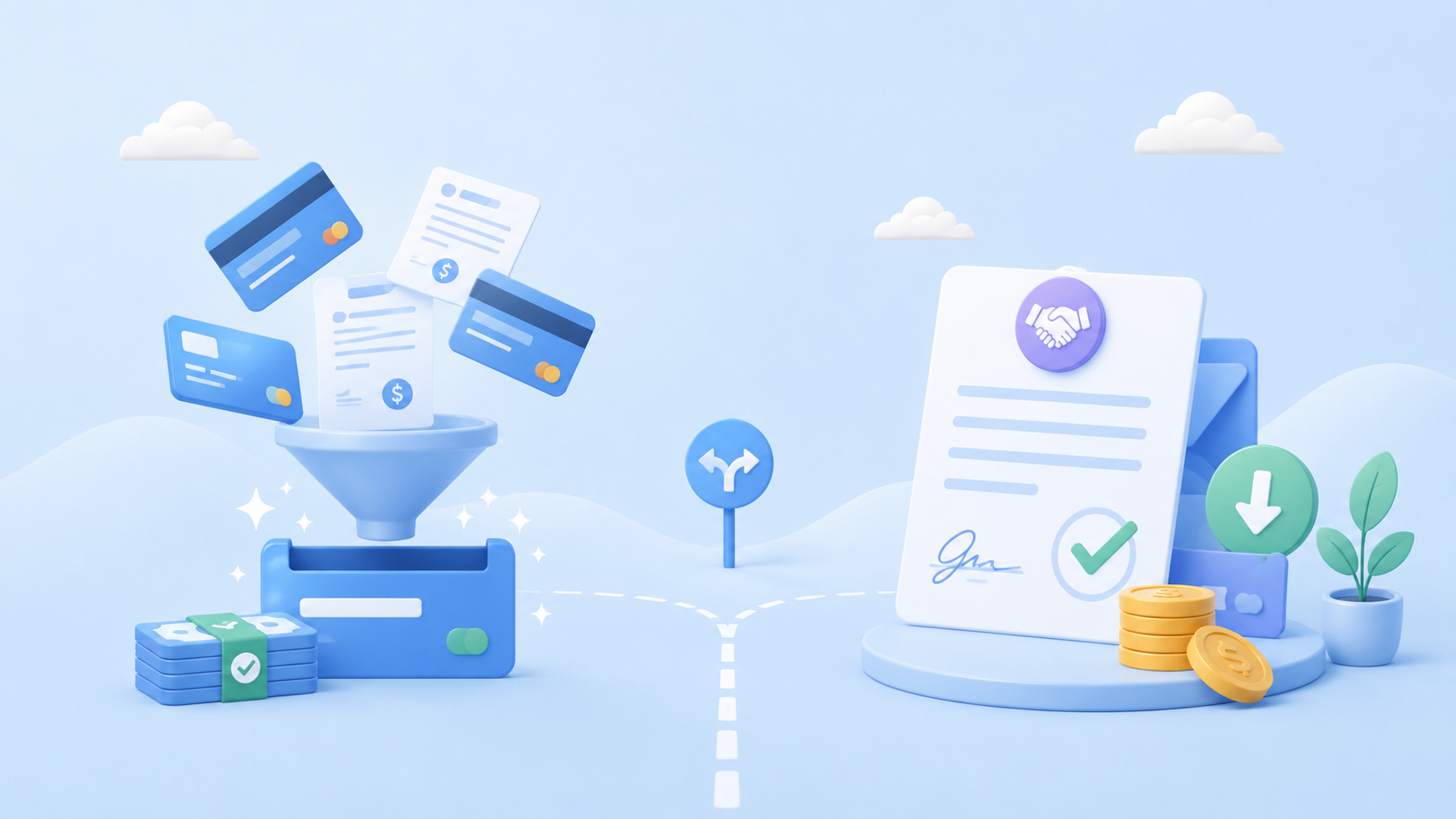
Debt consolidation changes how you repay the debt. Debt settlement may change how much you ultimately repay.
Neither option is automatically better. The right fit depends on whether your accounts are current or overdue, whether you qualify for affordable loan terms and whether paying the full balances is realistic.
This guide explains:
- How debt consolidation works
- How debt settlement works
- The costs and risks of each
- How each option may affect your credit
- When one option may make more sense
- How Relief helps you explore consolidation and lower-balance options
What Is Debt Consolidation?
Debt consolidation combines one or more existing debts into a new loan or credit account.
The new credit is used to pay off the original accounts. You then make payments to the new lender according to the new interest rate, monthly payment and repayment period.
Debt consolidation does not erase debt or reduce the principal automatically. It reorganizes what you owe into a different credit product. Depending on the terms, consolidation may simplify repayment or lower your interest costs—but it may also cost more over time.
Common Types of Debt Consolidation
Debt consolidation may involve:
- A personal loan used to pay off credit cards or other loans
- A balance-transfer credit card
- A home equity loan or home equity line of credit
- A loan offered through a bank, credit union or online lender
- A debt management plan administered by a nonprofit credit counselor, although this is not technically a new consolidation loan
Be careful when reviewing advertisements. Some companies use the term “debt consolidation” even when the service being offered is actually debt settlement. The CFPB recommends confirming whether you are applying for a new loan, entering a repayment plan or being told to stop paying creditors while money is accumulated for settlements.
How Debt Consolidation Works
The basic process usually looks like this:
1. You Apply for New Credit
The lender reviews information such as your:
- Credit history
- Income
- Existing monthly payments
- Debt-to-income ratio
- Employment information
- Requested loan amount
Approval, interest rates and fees depend on the lender and your credit profile.
2. The New Account Pays the Existing Debts
If approved, the loan proceeds may be sent directly to your creditors or deposited into your account so you can pay the balances.
Afterward, the original accounts should show lower or zero balances once the payments are processed.
3. You Repay the New Lender
You make one payment under the new loan’s terms.
Those terms may include:
- A fixed or variable interest rate
- An origination fee
- A set monthly payment
- A repayment period
- Late-payment fees
- Other lender charges
The new monthly payment may be lower because the interest rate is better—or simply because the balance has been spread across a longer repayment period.
A lower payment does not always mean a lower total cost.
Potential Benefits of Debt Consolidation
Debt consolidation may:
- Replace several due dates with one monthly payment
- Provide a fixed repayment schedule
- Lower interest costs when the new rate is significantly better
- Make budgeting easier
- Help you avoid additional missed payments
- Allow you to pay off high-interest credit card balances faster
These benefits depend entirely on the new loan terms and your ability to make every payment.
Risks of Debt Consolidation
You Still Repay the Full Balance
Consolidation does not reduce the principal you owe. You repay the new loan balance plus interest and applicable fees.
The New Loan May Cost More
Origination fees, balance-transfer fees, variable interest rates or a longer repayment period can reduce or eliminate the expected savings.
The CFPB warns that a consolidation loan may ultimately cost more than continuing to repay the original debts, particularly when fees or rising interest rates are involved.
You May Not Qualify for Better Terms
If missed payments or high balances have already affected your credit, you may not qualify for an interest rate low enough to make consolidation worthwhile.
You Could End Up With More Debt
After credit cards are paid off, the available credit may become tempting to use again.
If you rebuild the card balances while still repaying the consolidation loan, you could end up owing more than you did before.
Secured Consolidation Can Put Property at Risk
Using a home equity loan, home equity line or another secured product to repay unsecured debt changes the risk.
Credit card companies generally cannot take your home simply because you missed a card payment. But when your home secures a consolidation loan, failing to meet the loan obligations could put the property at risk.
When Debt Consolidation May Make Sense
Debt consolidation may be worth considering when:
- Your accounts are current or only recently late
- You have reliable income
- You can afford regular monthly payments
- You qualify for a meaningfully lower interest rate
- The fees do not eliminate the savings
- The new repayment period is reasonable
- You are committed to not rebuilding the original balances
- Repaying the full amount is realistic
It is usually most useful for someone who can continue paying but wants a simpler or less expensive repayment structure.
What to Review Before Accepting a Consolidation Loan
Do not compare offers based only on the monthly payment.
Review:
- The annual percentage rate
- Whether the interest rate is fixed or variable
- The origination or transfer fee
- The monthly payment
- The repayment period
- The total amount you will repay
- Late fees
- Prepayment penalties, if any
- Whether collateral is required
- Whether the lender pays creditors directly
- What happens after an introductory rate expires
The most useful comparison is the total cost of repaying the new account against the estimated cost of keeping your existing debts.
What Is Debt Settlement?
Debt settlement is an agreement in which a creditor accepts less than the full balance to resolve an account.
Unlike consolidation, settlement does not involve taking out a new loan. The goal is to obtain creditor approval for a lower amount.
Settlement generally applies to unsecured debts such as:
- Credit cards
- Personal loans
- Certain collection accounts
- Some eligible past-due medical accounts
It is usually considered after an account is already significantly overdue or in collections. Creditors are not required to accept a lower amount, and no service can guarantee approval.
Important: Relief does not encourage anyone to stop making payments or intentionally allow accounts to become overdue. Missing payments can lead to fees, credit damage, collection activity and lawsuits. Debt settlement is an option for people whose debts have already reached that stage.
How Debt Settlement Works
1. The Debt Is Verified
Before submitting or accepting a lower-balance request, confirm:
- The debt belongs to you
- The balance is accurate
- The creditor or collector is legitimate
- Payments and credits were properly included
- The account has not already been resolved
Do not settle an incorrect debt. Dispute it instead.
2. A Lower-Balance Request Is Submitted
The request asks the creditor to accept a reduced amount.
The creditor may consider factors such as:
- How long the account has been overdue
- The account balance
- The collection status
- The proposed payment amount
- Your financial information
- The creditor’s internal policies
3. The Creditor Reviews the Request
The creditor may:
- Accept the requested amount
- Offer different terms
- Request additional information
- Decline the request
- Take no action
A pending request does not automatically stop collection activity, interest, credit reporting or a lawsuit.
4. You Review the Terms
If the creditor provides an offer, review:
- The final amount
- Whether payment is due at once or over time
- The payment dates
- What happens if a payment is missed
- How the account will be reported
- When the account will be considered resolved
5. You Complete the Required Payments
The account is not resolved simply because an offer was issued.
You must accept the terms and make the required payments. Keep the written agreement and every payment confirmation.
Potential Benefits of Debt Settlement
Debt settlement may:
- Reduce the principal balance if the creditor agrees
- Provide a defined amount for resolving an overdue account
- Make resolution possible when full repayment is unrealistic
- Help close an account that has remained in collections
- Avoid taking out another loan
- Provide scheduled payment terms in some cases
These benefits depend on creditor approval and completion of the agreement.
Risks of Debt Settlement
Approval Is Not Guaranteed
A creditor can decline the request or provide terms you cannot afford.
Credit Damage May Continue
Settlement is usually considered after late payments, charge-offs or collections have already affected the credit report.
Debt settlement services may also negatively affect credit when consumers are instructed to stop making payments. The CFPB warns that unpaid accounts may continue accumulating fees and can lead to lawsuits while money is being saved for future settlements.
The Account May Be Reported as Settled for Less
After the agreement is completed, the creditor may report the account as:
- Settled
- Settled for less than the full balance
- Paid for less than the amount owed
- A zero-balance account with a settlement notation
The exact reporting language depends on the creditor.
Collection Activity May Continue
Submitting a request does not automatically require the creditor or collector to stop contacting you.
A separate cease-and-desist request may be needed to stop most communications from a covered third-party collector.
The Creditor May Still Sue
A pending settlement request does not prevent a lawsuit.
If you receive a summons or complaint, respond by the deadline shown in the papers. Do not assume settlement discussions have paused the case.
Forgiven Debt May Be Taxable
Canceled or forgiven debt is generally considered taxable income unless an exception or exclusion applies.
A qualifying creditor that cancels $600 or more may issue Form 1099-C. However, canceled debt can still be taxable even when it is less than $600 or no form is received.
A tax professional can help determine whether an exclusion, such as insolvency, applies.
Debt Consolidation vs. Debt Settlement: Side-by-Side
Which Option Might Be Right for You?
Debt Consolidation May Be the Better Fit When:
- Your accounts are still current
- You have steady income
- Your credit qualifies you for favorable terms
- You can repay the full principal
- You want one payment instead of several
- The new loan lowers the total repayment cost
- You want to avoid further delinquency
Debt Settlement May Be the Better Fit When:
- Your unsecured debts are already significantly overdue
- Accounts are in collections
- Full repayment is no longer realistic
- You cannot qualify for an affordable consolidation loan
- You can afford the creditor’s reduced payment terms
- You understand the credit and tax trade-offs
- You are prepared for the possibility that the creditor may decline
Neither May Be the Right First Step When:
- The debt is incorrect or does not belong to you
- Your payment problem is temporary
- A creditor hardship program could help
- A nonprofit debt management plan is affordable
- Most of your debt is secured
- You need court protection from several creditors
- Bankruptcy may provide a more appropriate legal solution
Nonprofit credit counseling organizations may help with budgeting and debt management plans, often at free or lower cost. A debt management plan generally focuses on structured repayment rather than reducing principal.
How Relief Helps You Compare Your Options
Relief is a self-service platform that helps users understand and take action on debt. It is not a lender, creditor, debt collector or law firm.
The right Relief option depends on whether the debt is still repayable through a new loan or has already become seriously overdue.
Compare Consolidation Offers With Payoff Loans
Through Payoff Loans, eligible users may compare debt consolidation loan offers from trusted third-party partners.
A consolidation loan may be worth reviewing when:
- You can continue making monthly payments
- Your accounts have not become seriously delinquent
- The new interest rate and fees reduce your overall cost
- You want to combine several balances into one payment
Relief is not the lender. The partner lender determines approval, interest rates, fees, loan amounts and repayment terms.
Before accepting an offer, compare:
- The APR
- The monthly payment
- The loan term
- Origination fees
- Total repayment
- Whether the payment is affordable
- Whether accepting the offer involves a hard credit inquiry
Request a Lower Balance With Relief Reduction
For users whose eligible unsecured debts are already at least 90 days past due, Relief may identify accounts that qualify for a lower-balance request.
Through the app, you can:
- Identify eligible overdue debt. Relief uses available credit information to locate supported accounts.
- Review estimated savings. The app analyzes available debt and financial information to show an estimated reduction.
- Submit a request. You choose the eligible account and authorize Relief to send the request to the creditor.
- Receive the creditor’s decision. The creditor may take up to 60 days to accept, decline or provide different terms.
- Pay the creditor directly. If you accept the offer, the creditor provides the payment terms and you pay according to the agreement.
Estimated savings and creditor approval are not guaranteed.
Understand Relief’s Fees
Relief charges a recurring membership fee for access to its platform and tools. Membership fees are separate from payments made to creditors and do not reduce your creditor balances.
Membership payments are generally nonrefundable after they are charged. A creditor declining a request does not create a guaranteed refund. Refunds may be available only under the limited conditions stated in Relief’s current terms.
Manage Collection Activity
Relief also includes tools for users dealing with collection activity.
Cease-and-Desist Requests
For an eligible collector, select the account and tap Send.
Relief sends the cease-and-desist request right away, and acknowledgment of delivery is generally available within three to five days.
A cease-and-desist request addresses most communications from a covered collector. It does not erase the debt, dismiss a lawsuit or stop a court deadline.
Violations Tracker
You can log:
- Calls and missed calls
- Voicemails
- Text messages
- Emails
- Collection letters
- Dates and times
- Screenshots
- What the collector said
Relief’s violations team reviews submitted information for possible collection-law violations.
Depending on the facts and evidence, the team may help seek compensation or use documented conduct to pursue an account resolution, which could include a lower balance. Results are not guaranteed.
Lawsuit-Response Support
If an overdue debt becomes a lawsuit, Relief provides three support options:
- An AI-assisted response included with eligible membership access
- A lawyer-prepared response for an additional fee
- Ongoing Attorney Representation — Starting at $650
Starting at $650, eligible users may be connected with an independent attorney for ongoing representation at a discounted rate. Pricing, availability and included services depend on the state, case and jurisdiction.
Relief’s tools are designed to help before an account reaches active wage garnishment. Relief cannot stop, reduce or reverse a garnishment once wages are already being withheld.
Questions to Ask Before Choosing
Before choosing consolidation or settlement, ask:
- Are my accounts current, recently late or already in collections?
- Can I realistically repay the full balances?
- What interest rate would I receive on a consolidation loan?
- How much would I repay in total?
- Are there origination or transfer fees?
- Can I afford the settlement terms if a creditor agrees?
- How would each option affect my monthly budget?
- Is the debt accurate and legally collectible?
- Could canceled debt create a tax obligation?
- Is there an active lawsuit or court deadline?
- Am I putting secured property at risk?
- Would a hardship plan, credit counselor or attorney be more appropriate?
Frequently Asked Questions
Does debt consolidation reduce what I owe?
Usually not.
A consolidation loan pays off the original debts, but you then owe the new lender. You generally repay the full amount borrowed plus interest and fees.
Does debt settlement reduce what I owe?
It may, but only when the creditor agrees.
The creditor can accept, decline or provide different terms. A request is not a guarantee.
Which option is better for credit?
There is no universal answer.
Consolidation may involve a credit inquiry and a new account. Settlement is usually associated with accounts that are already delinquent and may be reported as settled for less than the full amount.
The effect depends on the rest of your credit report and how the account is handled afterward.
Can I consolidate debt that is already in collections?
It may be possible to qualify for a loan, but serious delinquencies can make affordable approval more difficult.
A consolidation loan also generally pays the collection balance rather than reducing it. Compare the loan’s total cost against other available resolution options.
Can I settle an account that is current?
Creditors generally reserve lower-balance resolutions for accounts that are already delinquent or in collections.
Do not intentionally stop paying to pursue settlement. Contact the creditor about hardship or repayment options while the account remains current.
Does submitting a settlement request stop collection calls?
Not automatically.
A lower-balance request and a cease-and-desist request serve different purposes. Use the appropriate communication tool separately when you want an eligible collector to stop most contact.
Can a creditor sue while a request is pending?
Yes.
A pending request does not prevent legal action or extend a court deadline. Respond immediately if you receive court papers.
Is canceled debt always taxable?
Canceled debt is generally taxable unless an exception or exclusion applies.
A creditor may issue Form 1099-C when it cancels $600 or more, but the tax obligation is not determined solely by whether you receive the form.
Can Relief guarantee that I will qualify?
No.
Loan approval is determined by the third-party lender. Debt-reduction eligibility and final terms are determined by account information and the creditor’s decision.
The Bottom Line
Debt consolidation and debt settlement solve different problems.
Debt consolidation may make sense when you can repay the full amount but want a simpler payment or lower interest rate.
Debt settlement may make sense when eligible unsecured debt is already seriously overdue and full repayment is no longer realistic.
Before deciding, compare the full cost—not just the monthly payment. Review the impact on your credit, the possibility of fees or taxes and whether you can afford the required payments.
Relief can help you explore both directions. Payoff Loans may help eligible users compare consolidation offers from trusted partners, while Relief Reduction helps eligible users with seriously overdue debt request a lower balance directly from supported creditors.
The creditor or lender makes the final decision. You decide whether the terms work for you.
Relief is a self-service platform and is not a lender, creditor, debt collector or law firm. Relief does not provide legal, tax, credit or financial advice. Consolidation loans are provided by third-party lenders. Legal services, when available, are provided separately by independent attorneys. Eligibility, estimated savings, loan approval, creditor approval, compensation and legal outcomes are not guaranteed. Features, pricing and availability may vary by account, state and jurisdiction. Court costs and filing fees may apply.


.svg)